

Now you can view the content of this issue of Socialist Viewpoint in electronic format on your Kindle, iPad or any other Reader that supports the PDF format.
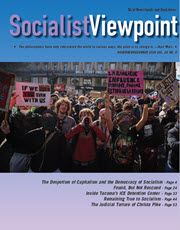 Click Here to Download a copy of this month's content
The Despotism of Capitalism and the Democracy of Socialism
By Bonnie Weinstein
Found, But Not Rescued
By Cathy Otten
Inside Tacoma's ICE Detention Center
By Sofie Villa
Remaining True to Socialism
By Paul Le Blanc
The Judicial Torture of Christa Pike
By Jeffrey St. Clair


The Despotism of Capitalism and
the Democracy of Socialism
|
Fightback!: |

Socialism is the arch enemy of capitalism because it challenges the very foundation of capital which is the private ownership of the means of production resulting in the vast accumulation of private wealth for the capitalist class and the impoverishment of everyone else.
Socialism also challenges capitalism’s right to protect their private wealth and privilege by force.
Socialism is founded upon the principle of a world governed by the masses of humanity—peacefully, democratically, and in the interests of all of life on earth—and for the majority’s democratic right to expropriate the massive private profits accumulated by the tiny few.
The lengths to which capitalism will go to protect power and wealth
In a September 15, 2026, New York Times article by Francesca Regalado, titled, “U.S. Has Deployed Weapons in Space, Air Force Secretary Says” the author reports:
“The United States has stationed weapons in Earth’s orbit, Air Force Secretary Troy E. Meink said on Monday, the first such public acknowledgment by a Pentagon official after years of preparations to counter potential deployments by Russia and China. ‘We are increasing readiness against existing threats, and the United States has on-orbit space control weapons capable of defending the Joint Force against hostile adversary action,’ he said at a convention in Maryland, according to a news release published on the Air Force’s website.”
This fact should strike terror in the hearts of everyone. Weapons in space for the sole purpose of having control of all the wealth and resources across the globe is irrational and despotic. It exposes the fact that there is nothing democratic about capitalism—in the end, what they can’t get by theft, persuasion or subterfuge, they will take by deadly force.
Shadow wars
Capitalists are competing in the world’s capitalist marketplace for the resources needed to increase their rate of profits, and war and violence are their modus operandi.
An October 10, 2026, Times article titled, “A Deadly Firefight Exposes Erik Prince’s New Shadow War in Congo” by Declan Walsh exposes U.S. involvement in Prince’s shadow war to steal a U.S. stake in the natural resources of the Congo, as just one example.
Erik Prince is an American businessman, who is the founder of Blackwater, the private military contractor noted for massacres in the U.S. wars against Iraq and Afghanistan.
In his article the author explains how Prince goes about his business of helping to secure U.S. mining interests in the Congo using the same violent methods he used in Iraq and Afghanistan:
“Mr. Prince’s growing influence in Congo comes as the Trump administration seeks a new toehold for American companies in the country’s lucrative mining industry, where China’s dominance over critical minerals like cobalt is a source of growing concern in Washington. Last December the United States and Congo signed an agreement granting preferential access to American mining interests in Congo, which many Congolese officials privately called a “peace for minerals” deal. … Western mercenaries have long been a sensitive subject in Congo, where hundreds of European fighters joined an effort by the Katanga region to secede in the 1960s. Many Congolese also remember the C.I.A.’s role in the overthrow of their country’s first prime minister, Patrice Lumumba1, who was later executed by a firing squad led by Belgian contract officers.”
“Hunter-killer drones”
In addition to killing over 200 fishermen2 in the U.S. boat strike campaign under the guise of fighting drug cartels in South America, Trump is sending “hunter-killer” drones not only to show the world the military superiority of the U.S., but to show that the American capitalist class will do all that it takes to secure their access to the natural resources of all of South America. It has nothing to do with eliminating the crisis of drug addiction that is killing millions.
In the October 6, 2026, New York Times article, titled, “U.S. Sends ‘Hunter-Killer’ Drones to South America to Target Cartels,” the authors, Annie Correal and Eric Schmitt report:
“MQ-9 Reaper drones—known for high-profile deadly strikes—have been shifted from Africa to Colombia and Ecuador, U.S. officials said. … The drone is capable of carrying thermal cameras as well as equipment that can intercept electronic communications, and it has been called the U.S. military’s ‘hunter-killer.’ …The Trump administration has made exerting greater influence in Latin America a priority, focusing especially on security. It has built a coalition of regional leaders that has pledged to help dismantle cartels; the group’s official slogan is ‘We do bad things to bad people.’ Washington has previously justified lethal strikes on drug traffickers by claiming that they are enemy combatants.”
There are no boundaries to capitalism’s greed
The epitome of this military aggression by the world’s capitalist class was outlined in an October 4, 2026, New York Times article by Selam Gebrekidan, titled, “Who Owns the Moon?”:
“In Robert Heinlein’s 1950 novella “The Man Who Sold the Moon,” a tycoon embarks on a quest to be the first human on the moon and proceeds to auction off title rights to the lunar surface. ‘There is going to be one hell of a fight one of these days over who owns the moon,’ he tells his fellow businessmen. ‘I want the deck stacked so that we win.’
The author, Selam Gebrekidan, goes on to explain:
“In that era, as the United States and the Soviet Union raced to the moon, the future that Mr. Heinlein envisioned looked like it might come true. To head off this concern, the superpowers made an agreement, the Outer Space Treaty of 1967. The moon, more than 100 countries agreed, belonged to no one. … The world’s superpowers are now racing to build nuclear-powered lunar bases, and corporate leaders have their own moon dreams. Elon Musk, a fan of Mr. Heinlein’s work, envisions ‘trillion-dollar markets’ including lunar data centers and a catapult for launching satellites deeper into space. Jeff Bezos wants to move heavy industry to the moon and leave Earth a ‘garden planet.’ The United States government is eyeing the helium, frozen water and other resources near the moon’s south pole.”
Meanwhile, the world’s working class is in a desperate financial crisis
In a September 7, 2026, Times article by Brent Neiman titled, “Why Labor’s Share of Wealth Is Shrinking”:
“Workers are earning a smaller and smaller share of the economy’s income. Their cut—referred to by economists as “the labor share”—has been falling for decades. And it’s getting worse. During the past few years, it declined at a rapid clip and is now at its lowest level on record—about 53 percent of income, down from about 65 percent after World War II. …When the share of income paid to capital—interest, rent, profits and dividends—rises, the labor share necessarily falls.”
Socialism is the key to workers’ power
In an August 24, 2026, Times article by Kim Phillips-Fein titled, “Is This a New Era of Class Warfare?” about a disgruntled warehouse worker, Chamel Abdulkarim, who was charged with torching a Kimberly-Clark warehouse.
Abdulkarim worked for a distribution company servicing the warehouse and was charged with arson that caused $600 million worth of damages.
The article’s author delivers a little history lesson comparing the conflict of wealth inequality between capital and labor since Carnegie’s time. He explains that Andrew Carnegie (1835–1919) was an industrialist, steel tycoon and major philanthropist who believed that:
“…the answer to class rage was for the rich to invest their money in philanthropic projects so that the poor would become convinced that they were benevolent at heart, able to steward the resources of society.”
The history lesson continues:
“American class relations continued to be fiercely violent after World War I, as companies and the government worked together to break the labor movement. Hundreds of immigrant radicals faced deportation following a series of bombings…. The class violence of the late 19th and early 20th centuries continued during the 1920s, in the mine wars of West Virginia, and the 1930s, when many corporations stockpiled gas equipment and guns to resist rebellion.
“Company security forces fired on unemployed workers at the Ford Motor Company in 1932 who were participating in a ‘hunger march.’
“Police officers killed strikers on the San Francisco waterfront in 1934, sparking a general strike.
“In Chicago three years later, police officers shot and killed ten pro-labor marchers in what came to be called the Memorial Day Massacre.
“Only days before, Ford security guards savagely beat up United Automobile Workers union leaders, including the union president, Walter Reuther, on camera—images that were carried in newspapers throughout the country.”
The article goes on to point out how economic inequality inevitably leads to social crisis:
“Societies in which there is an extreme division between the wealthiest and the rest tend to be politically unstable ones as well. … Inequality makes it virtually impossible to sustain the feeling that we’re all part of the same political project, and so it makes it hard for people to believe that democratic government is possible—that we all have a common stake in society. Small numbers of people with great fortunes come to exercise disproportionate political power. … But what matters is how this class anger is expressed, whether it leads to nihilism or solidarity, to isolated rage or collective action. By so profoundly weakening many of the institutions that once nurtured collective action—labor unions, political organizations, protest groups—our society has made itself one in which people torch warehouses.
And while it doesn’t call for socialism as an alternative to capitalism, it does hit the nail on the head of the problem:
“What we need is a more viable path to a better world, or at least a more equal one.”
Money
Money separates the haves from the have-nots, yet it’s the have-nots that create the wealth through our labor power. Unless we are already born to wealth (a tiny minority of humanity) we are obligated to work in order to get any of the wealth we create because the “haves,” the capitalist class, own the product of our labor and the means of production to produce it.
Nothing comes to the working class for free. Even the air we breathe is not totally free. If we live near a refinery, we pay for the air we breathe with poor health—and then we have to pay for healthcare.
Us against them
Class society is one where there is a small minority class that protects its privilege of private ownership of the wealth produced by the masses through the threat of force and violence.
Class conflict has existed for millennium. And today, the gap between the haves and the have-nots is wider than it has ever been.
All capitalist conflicts around the world are really battles for private control of the resources of the world and for access to cheaper labor.
Capitalist philosophy is that those with the biggest guns, win the biggest bounty of both wealth and power over the masses that create that wealth.
But, in reality, they can only have the power that we, the masses, are tricked into giving to them.
The power of labor solidarity in action
Just how much we get paid for our labor is really up to us because we only get as much as we unite and fight for.
Together we are the overwhelming majority, and we have the power to take control over all the wealth we produce. And, in fact, if we had control over the bounty of our labor, we would have no need for money.
We have been hoodwinked into believing that those in power over us deserve their status because they are better than us—the cream of the crop. “Their money”—the money they have stolen from the wealth our labor produces—allows them all the luxuries imaginable.
They and their children not only get the best education, but they automatically have a share of the family wealth and the privilege and power it brings them.
You don’t need any intelligence to inherit wealth, and power.
Humanity’s worth
Capitalism’s measure of the worth of the masses of human beings depends primarily on how much money we, as individuals, have been able to accumulate on our own, while born to a family with no property or wealth. (Capitalists have a different criteria of worth for themselves.)
To have power over us, they must make us believe that our neighbors are our enemy, that people different than us are our enemy. Most importantly, people poorer than us are our enemy.
Money is the most powerful tool capitalism uses to divide us. Yet they must divide us further on the basis of race, religion, sexual identity—pitting us against each other in every way possible—to keep us from identifying them, and the capitalist system they run by force and violence to maintain their wealth, as the central problem humanity and the world faces today.
World in turmoil
On Saturday, October 17, 2026, over 800,000 French students and workers united and took to the streets and brought France to a halt to protest dilapidated schools and drastic austerity measures especially targeting services to the poorest communities. The outrage across the country is growing, and more demonstrations have been scheduled in the coming weeks.
Workers everywhere are feeling the degradation of their living standards while the gap between the rich and the poor is wider than it has ever been.
We need more than demonstrations. We need organization. We need to build a movement independent of, and in opposition to, the capitalist class and the entire capitalist system. We need to build organizations designed to defend our democratic right to the wealth we create.
Ending capitalism and building socialism is the only way we can rationally plan an economy where everyone is able to contribute to the best of their ability, and share the product of our cooperative labor equally—from each according to ability, to each according to need and want—a society based upon freedom, democracy, economic and social equality and justice for all—a socialist society that can satisfy the needs and wants of all, while preserving the only planet and moon we all share.
1 Patrice Émery Lumumba was a Congolese politician, independence leader, and revolutionary who served as the first prime minister of the First Congolese Republic (modern day Democratic Republic of the Congo) from June until September 1960, following his party’s success in the May 1960 election. Lumumba was the leader of the Congolese National Movement (MNC) from 1958 until his assassination in 1961 aided by the C.I.A. Ideologically an African nationalist and pan-Africanist, he played a significant role in the transformation of the Congo from a colony of Belgium into an independent republic.
2 “The U.S. Boat Strike Campaign Has Now Killed Over 200 People”
